What areas does BassDMS cover?
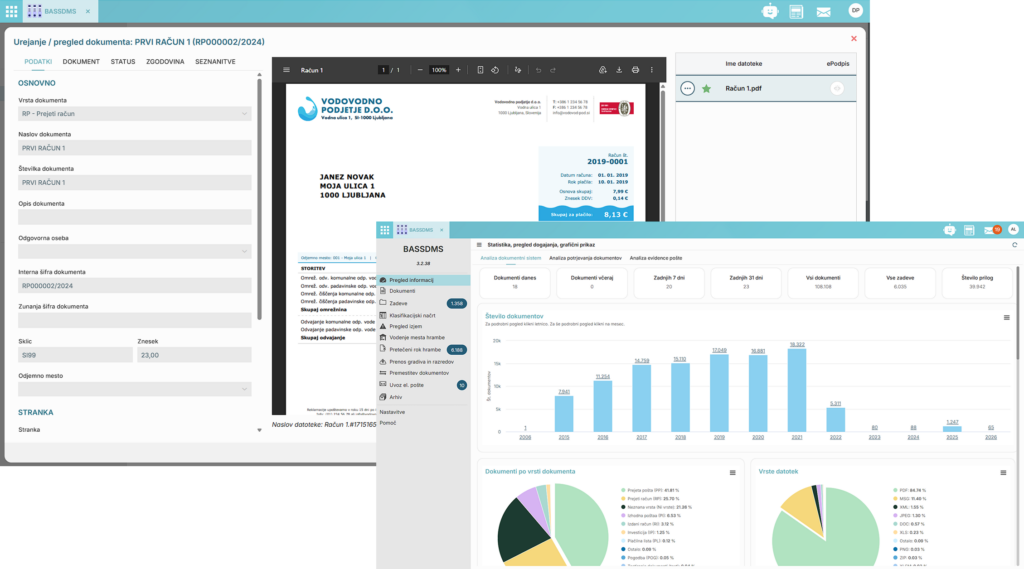
BassDMS is a certified and secure document management system that enables fast entry, efficient search, and long-term document storage. With flexible access rights, electronic approvals, and mobile use, it optimizes business processes, reduces costs, and increases company productivity. We are also connected to most ERP systems in Slovenia (e.g. integration via the VOD standard), so integrations with other systems do not cause any issues.

What are the main goalsthat we strive to achieve with the implementation of BassDMS in your company?
- Ensure maximum security of your data and documents
- Provide administrative simplification and faster access to documents when you need them
- Offer a solution that adapts to your business processes and develop it in line with the needs of your organization
We recognize the importance of prudent document handling, which is why the security of your documentation we place in first place.



DMS implementation timeline
Presentation
Proposal and alignment
Current-state assessment and business process mapping
Definition of the planned timeline
Implementation and user training
Practical use and support team assistance
Frequently Asked Questions
Q1: How does OCR work and why is it essential in document capture?
OCR (optical character recognition) enables the conversion of scanned documents and images into machine-readable text. It is used in the digitization of paper documents, the import of invoices, contracts, and other documentation, and it enables content search and automatic data capture. With OCR technology, documents are quickly enriched with metadata, which further speeds up the search and classification process.
Q2: What does advanced document search enable and what is the role of the classification plan?
BassDMS is designed to provide an excellent user experience. It is clear, logical, flexible, and intuitive even for users encountering document systems for the first time. Advanced search enables searching by metadata, document content, and a combination of multiple criteria at once. Users can filter documents by type, date, status, owner, content, and more, making documents available whenever you need them. The classification plan plays a key role here, defining a unified and logical structure for classifying documents according to business processes or content, increasing transparency and enabling faster search and simple archiving (automatic retention-period assignment).
Q3: What are the audit trail and timestamp, and why are they extremely important?
The audit trail provides complete visibility into all activities performed on documents (views, edits, approvals, changes). Each event is precisely linked to a specific user, ensuring traceability and control over the use of documentation.
The timestamp complements the audit trail with proof of the exact time a document was created, approved, or changed. It is especially important for documents with legal or regulatory significance, as it ensures evidentiary value, authenticity, and compliance with legislation.
Q4: What are access rights and approval workflows?
Access rights determine who can view, edit, approve, or delete an individual document or folder in the document management system. They are based on roles, user groups, or individual settings and ensure data security and confidentiality.
Approval workflows are predefined procedures according to which a document moves between responsible persons in review and approval processes. The system automatically routes the document to the next approver and records all steps and decisions. Automatic assignment and receipt of documents enable faster flow and eliminate bottlenecks. This also significantly simplifies staff substitutions, as the system automatically reroutes tasks and approvals to authorized persons during absences. This ensures the transfer of responsibilities and authorizations without disruptions or interruptions to business processes.
Q5: How does BassDMS encourage employee collaboration?
As part of implementing the document management system, we also offer a solution that enables collaborative editing of various types of documents. Employees can share documents and work on or complete them simultaneously. This way of working reduces the risk of using different versions or losing them.
Q6: How do we ensure the security and storage of your documentation?
Our solutions are based on the principles of secure, certified, and legally compliant document storage. BassDMS is designed to replace traditional paper archiving with a digital model. A document stored in BassDMS therefore has the same legal validity as a physical document, the risk of loss or unauthorized access is reduced to zero, and you eliminate all costs associated with a physical archive. Our document management system is supported by security mechanisms, access control, timestamps, and audit trails. Compliance with archival legislation and personal data protection law is also ensured. During implementation, you can choose between local or cloud storage. In the latter case, your data is stored in a highly secured server facility in Slovenia.
Q7: What does it mean that the BassDMS solution is reliable?
Reliability is one of the foundations of software development, which is why our system is built on technologically stable solutions that ensure uninterrupted operation. Upgrades are carried out in a controlled manner and at predefined times, while we also regularly provide improvements, optimizations, and fixes. We also provide support and maintenance that reduce the risk of possible interruptions and increase trust in the software environment. The reliability and quality of our solutions are also confirmed by internationally recognized ISO 9001, ISO 27001, and ISO 27701 standards.
Q8: Which devices does BassDMS support?
Working in the BassDMS application is simple and fast thanks to its web interface, which enables operation independently of the operating system (Windows, iOS, Android) and can be accessed from any device (computer, tablet, mobile phone). Broad accessibility is crucial for field work, as employees can access the desired documents anywhere and at any time. This enables faster decision-making and approvals, as well as uninterrupted workflow even outside the organization's business premises.